

How to support Child Language Development during the School Holidays
It’s time for teachers and students nationwide to take a well-deserved break.
Despite that, learning and language development do not take a holiday for children and young people!
If your child receives language intervention, or you just wish to continue to support their speech, language and communication development over the break, Chatterbug is here to help. Read our selection of top tips to help your child progress.
Why is aiding development important?
Speech, language and communication skills are essential for your child’s academic, social and emotional development. Having adequate communication education ensures your child can build relationships with peers and express their needs and requirements.
Without this, they may struggle to maintain attention in lessons, with difficulties in language comprehension and listening and making social connections. Falling behind in school and friendships can lead to comorbidities and potential mental health struggles.
By maintaining language development outside of school you can build your relationship with your child. You may also notice any areas of concern and can support your child to receive the necessary intervention.
What areas of Speech and Language require focus?
Speech and Language Therapy does not just cover how well you understand what your child is saying! A wide range of areas require equal focus to improve your child’s language development.
Vocabulary
Whilst vocabulary isn’t the only area of language development, it is still an integral part. Ensure your child uses the correct vocabulary and definition (for their age group). Whilst there are no strict rules for vocabulary development, there are generic outlines that can help indicate whether your child may need some help with this. For example, around 2-3 years your child should be in the telegraphic stage of speech and language development. At this point, your child may start constructing sentences with 3-5 words with grammatical categories (noun, verb, adjective), rather than 2-word sentences.
Grammar Skills
Correct grammar displays when a child understands the structural constraints of language. For example, whether they know the general structure of sentences and the ability to request with verb>noun structure (e.g. ‘want bottle’). Whilst this is not grammatically correct, it indicates the child knows how to use the language structure. It is natural and expected for your child to make grammatical errors as they explore the rules of language!
Turn-Taking
Our ability to hold a conversation with others and build relationships relies on turn-taking. This is the natural flow of conversation as it switches between speakers. E.g.
Turn 1: ‘Hello, how are you?’
Turn 2: ‘Hey, fine, thanks. How are you?’
Turn-taking shows an understanding of social conventions around language. Egocentric language (one speaker not allowing another to take their turn) or failure to respond to another person might be perceived as rude in the neurotypical society.
Storytelling Abilities
The ability to tell a narrative is a significant part of social interaction that we use on a daily basis to build relationships by sharing our experiences. Holding a narrative shows a more complex understanding of language structure and meaning. Imagination is required for play and social interaction, strengthening your child’s connection with the world around them.
Narratives also allow your child to tell you about their day and experiences, making it a vital communication skill.
What strategies can promote language development?
Language and interaction are part of everyday life! However, in early years, it’s beneficial to give some extra attention to them.
How do you support your child?
Regular Conversation
Interact with your child! To encourage conversation, talk to your child about things that interest them. However, if you build an ask-and-answer structure, you may pressure your child to respond. Instead, try commenting on your surroundings (e.g. ‘oh look, those are lovely horses!’) and allow silence for them to fill. The natural gap will mean your child feels less pressure to respond but leaves them the opportunity to do so. Using this strategy, children often give longer responses than when asked a direct question.
Making regular conversation and interaction about the world around your child means they will also learn new words and grammatical structures from you!
Colourful Semantics
Colourful semantics is a method of helping your child construct sentences on their own, through colour coding! Splitting words into who, action, what are they using, where and when helps your child to learn which word types fit where in a sentence and expand their vocabulary. It also provides sufficient independence to piece together their own sentences and understand grammatical rules. This independence will allow your child to express their thoughts and ideas more adequately.
Imaginative Play
Imaginative play allows children to play out and practice scenarios they have seen or adapted from real life. Play is essential for building narratives and can contribute to skills like turn-taking. It even allows them to see the structures of social interactions and practice this.
Imaginative play supports the development of narrative skills! It can show your child how to imitate life skills (e.g. washing, cooking, working) and the sequencing of these activities. Emulating what they have seen in adult interactions may teach them skills like sharing. After all, play is a shared experience!
Bedtime Stories
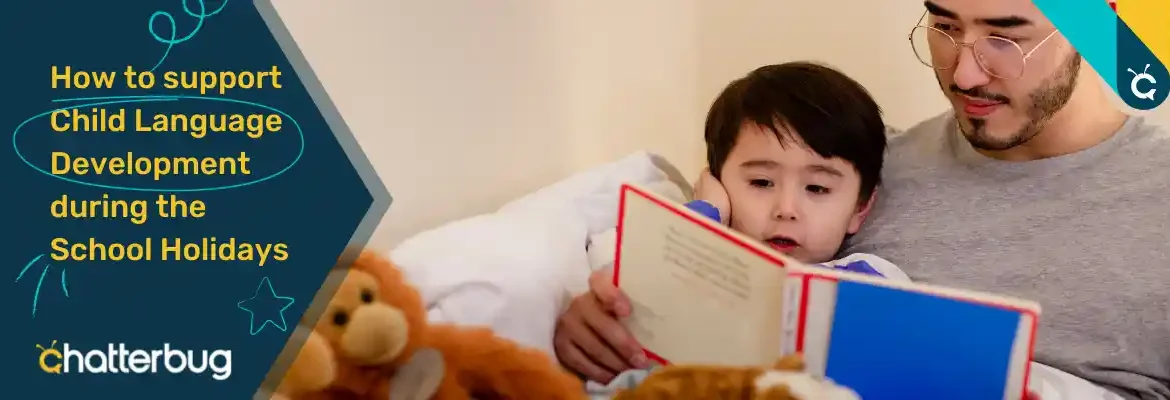
Bedtime stories are a great way to help build narrative structure and sequencing into your child’s language development, with the potential of learning new vocabulary. Bedtime stories have proven to be beneficial for a child’s literacy skills and language comprehension. Plus it’s a great opportunity to snuggle up and have some quality time with your child.
Flashcards
Flashcards are a great strategy for vocabulary building. Ensure each flashcard has the word and visual aid (bonus points if you have the sounds on the card, too!). Ask your child to define the word/object on the flashcard. You can ensure they have a good understanding of the vocabulary they use.
You can use flashcards to help with sentence building too. Try using the word in a sentence to build context with its definition. You can also try separating the cards into word categories (nouns, verbs, adverbs, adjectives) and ask your child if they can build a sentence when you’re practising.
Support from Chatterbug
If you are concerned about your child’s language development, never fear! Chatterbug can offer assistance in a variety of ways.
Training
We offer a variety of training courses to help upskill parents/professionals who are supporting language development, especially for children with SLCN. These courses range from Colourful Semantics we mentioned earlier, to Supporting Children with DLD.
You can browse our full range of training courses here.
Assessments
If you believe your child is having difficulties in their language development or is displaying signs of SLCN, Chatterbug can offer some assessments, such as SLCN Assessment, or Autism Assessment Panel. Our team of Speech and Language Therapists will be able to identify if your child has any Speech, Language and Communication Needs and create a personalised intervention plan!
Intervention
Following diagnosis, we have a team of professionals and specialists to ensure that your child is getting the necessary therapeutic intervention. This can make huge steps to ensure your child is having all their educational and emotional needs attended to.
We offer intervention face-to-face and via telehealth.
You can view our full range of assessments and services here.
Want more information?
To speak to the team about services or assessments, contact us on:
Phone: 0113 240 8510 Email: [email protected]
Or fill out the contact form below: