

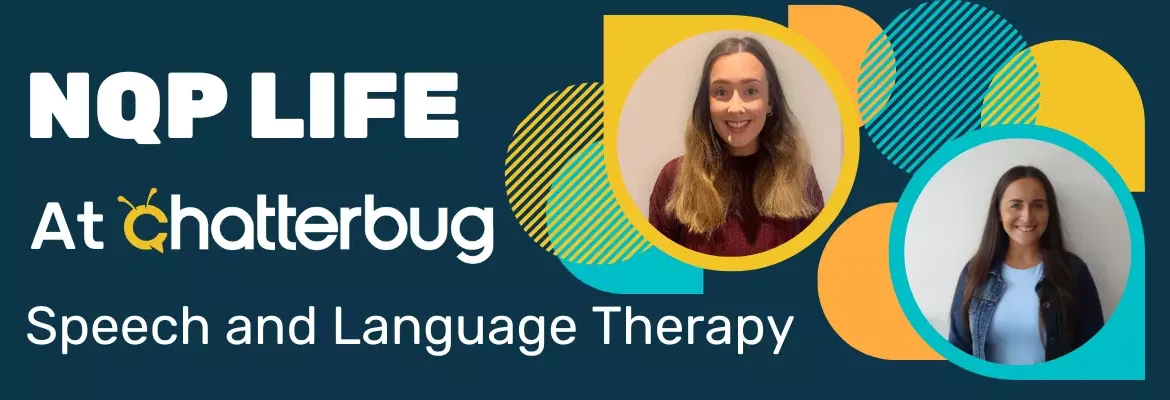
Being an NQP can feel daunting – your first time in the field as a qualified Speech and Language Therapist! Our SLTs Orla and Olivia are to provide their best tips and tricks about their first year here at Chatterbug.
Was Chatterbug your very first SLT role?
Orla: I came straight from my undergraduate degree – so Chatterbug was my first role! I applied to a couple of places, but I knew the private sector was the place for me. I wanted consistency and to see regular clients – and then I stumbled across this NQP role and I’ve been here ever since!
Olivia: I came from my masters degree, but actually, while I was doing my masters I worked for Chatterbug part-time. So for a few months, I was working here and when I came towards the end of my degree I was lucky enough that Chatterbug offered me an NQP role!
Was there anything in particular that drew you to Chatterbug?
Orla: When I was first looking, I was torn between Manchester and Leeds. But due to the pandemic, I didn’t feel like my time in Leeds was up yet! I started hunting for NQP jobs in Leeds and Chatterbug was one of the first I came across. When I was reading through the job description I could really see myself here and I knew this was where I wanted to be.
Olivia: What really drew me to Chatterbug was the Youth Justice side of things, which is actually based in Halton. I had a real interest in this in uni and not a lot of places offer it! Funnily enough, I’ve moved away from that now.
I was definitely interested in finding out more about the private sector too, it’s just not really mentioned when you’re at uni! It makes it quite appealing when it’s advertised.
Are you glad to have come to Chatterbug for your NQP role?
Orla: I know, compared to other companies or the NHS, there’s a huge focus on what you want to do and how you can progress. Everyone here takes you for exactly who you are. You never get bored with the job which is one thing I will always say! I know that here I’m always doing something I want to do.
Olivia: I agree. Even during our Line Management, they’re always asking what area we’re interested in and looking at the potential of developing into that area. We’re extremely lucky for that, as many NQPs don’t have this.
Has there been anything in this last year that you weren’t expecting or wish you’d known about before?
Orla: When we first started it was so overwhelming. But in hindsight, we wouldn’t have it any other way. You know you have the training and you’re capable, and you get thrown straight into the deep end. It means you just get on with the job you need to do. I’m almost glad it works the way it did!
Olivia: It is that cliche that you learn everything on the job – you really do! There’s not so much the degree can do to prepare you for reality. Even though you get thrown in the deep end, you have so much support whenever you need it. But we have learnt a lot along the way!
A big shock will have come as we had the COVID uni experience, so all our placements were telehealth! It felt a lot more real when we were there giving therapy in person.
Is there anything you would have gone back and changed or told yourself?
Orla: Absolutely not. I wouldn’t ever change the journey because now I look back and think to look how far you have come!
Olivia: I think the only thing I would have told myself was to slow down and take my time. When you first start there are so many schools and children and caseloads and you just want to scramble to get through them! But you will make it so just take your time.
Did you ever feel the effects of impostor syndrome – or do you still feel it?
Orla: Oh, absolutely. When I started here I was an NQP fresh out of uni and only 21. I thought that teachers would just look at me and think what does she know. That for me took a lot of telling myself I did my degree and training, I can do this, and I know what I’m doing.
Olivia: I get the same. You get a lot when you’re younger about ‘how long have you been doing this’ and maybe doubting your ability, which can really secure that idea in your brain. It can make you feel pretty rubbish in that moment – even if they don’t mean it!
All of our schools really appreciate our input and we know this is where we belong. You will always find strategies if you take the time!
What’s been your favourite Chatterbug moment?
Orla: I have one child that will always stick out for me. He was one of my secondary students and he was really struggling with his emotional regulation. He was often getting excluded and in detention.
We worked together on his regulation zones in therapy, and in his last session that he’s taken what he’s learnt and used it in the classroom. This was such a huge moment for me because I knew I was making a real impact. He’s no longer being excluded and in detentions less and he’s even enjoying being in school.
Olivia: There are a few for me, but I just feel grateful for the little moments, like Orla said. I’ve recently been working with a girl with selective mutism. She’s just built up her confidence to answer some questions in class which is really special to me.
There are a few stand-out moments too, like the first time I provided training for schools which is the first ‘I’m a professional’ moment!
What’s the support like as an NQP at Chatterbug – do you have a good rapport with your line management?
Orla: Absolutely. Trust her with anything and will tell her anything. I know that she’ll support me no matter what! She really just wants us to progress as people and therapists. It’s not limited to your own line manager either, all of them will make time for you.
Olivia: One hundred per cent. She always takes on what we say and gives us loads of opportunities in our area of interest. She is great at supporting our well-being and has our best interests at heart. It’s not even during line management, I always know I can pull her to one side if I need to talk about something.
When was the moment that you realised you were really part of the Chatterbug team?
Olivia: There’s loads of team building we do outside the office. All our away days and staff get-togethers really help you socialise and get to know everyone on that extra level.
Orla: I love social events too. A big thing to me is little comments. When someone asks a question and the response is ‘Oh Orla or Olivia can help you with that’ it’s such a boost. We know they can trust us and rely on us then.
We’re lucky to be such a diverse group that gets on so well!
Do you feel like you make special connections with the schools?
Olivia: Making that connection is half the job! You need to build those relationships and I love that part of the job. They are just as important as the intervention you’re offering – it helps raise SLCN awareness too.
Orla: When you first get started, building those relationships is so important! You’re taking a child out of their class and you need them to understand it. If you don’t build that up, they’re not coming out of their class.
Even with private clients, you get very involved with their families. You need to know how they get on in school and at home.
Have you been working towards any speciality so far?
Olivia: We both have the same interests actually. We’re both looking to specialise in autism! What really got me into Speech Therapy as a career was that I was working with a boy with autism at a previous job, which was where my interest started.
In my undergrad, childhood studies, I was looking into the youth justice system there. At this time I didn’t even know it was speech therapy related! So those 2 are the big areas I have the most interest in potentially specialising in.
Orla: I’m the same. Autism and youth justice! When I first started at Chatterbug I was given a secondary school, and I really did not want to work with teenagers as I didn’t think it was for me. But when I got there, I ended up loving it!
I went back to my Line Manager and asked for more experience. Now I have one of the AIPs which is where children go if they have been excluded or need a break away from the school. I can then provide their intervention.
What are your next steps?
Orla: Next step is to do our competencies! This means we’ll no longer be NQPs, but there are no strict timelines for this. We were recommended to take 6 months and actually learn the job. This was the best thing to do because it stopped me from being overwhelmed and we actually know what we need to pass them.
Olivia: Our competencies are ahead of us! Giving ourselves time to learnt the job has made it so much easier and understand the evidence we needed to provide. But it’s other exciting things like joining the training team and delivering this to teachers and parents.
Keep an eye out for our ‘A Cup of SLTea Podcast’ episode with Orla and Olivia to discuss in more detail NQP life at Chatterbug!
Interested in becoming an NQP at Chatterbug?
Check out our available vacancies on our careers page.
Get in touch with our team on:
Phone: 0113 240 8510 Email: [email protected]
Or fill out the form below: